
The U.S. economy and its stock market are deeply intertwined—but not always in the way investors expect. While strong Gross Domestic Product (GDP) growth is often seen as a positive economic indicator, the stock market doesn’t always move in lockstep with it.
So, what’s the real relationship between U.S. GDP trends and stock market growth?
In this blog, we’ll explore:
- What GDP is and how it’s measured
- Historical U.S. GDP trends
- The connection (and disconnection) between GDP and stock returns
- Factors influencing the correlation
- What this means for long-term investors
What Is GDP?
Gross Domestic Product (GDP) is the total market value of all goods and services produced within a country in a given time period—usually reported quarterly or annually.
Components of U.S. GDP:
- Consumer Spending (C)
- Business Investment (I)
- Government Spending (G)
- Net Exports (X – M)
GDP is considered the broadest measure of economic activity and is often used to determine whether the economy is growing or in recession.
Historical U.S. GDP Trends
Let’s take a quick look at how U.S. GDP has performed in recent decades:
| Year | Real GDP Growth | Notable Events |
|---|---|---|
| 2008 | -0.1% | Great Recession begins |
| 2009 | -2.5% | Financial crisis deepens |
| 2010–2019 | 2–3% avg | Steady post-crisis expansion |
| 2020 | -3.4% | COVID-19 pandemic crash |
| 2021 | +5.7% | Rapid recovery, stimulus-driven |
| 2022 | +2.1% | Inflation and Fed rate hikes begin |
| 2023 | +2.5% | Resilient consumer spending |
| 2024 | +2.2% | Slowing growth, tighter policy |
| 2025 (est.) | ~2.0–2.3% | Modest expansion, high interest rates |
While GDP growth offers a pulse on the economy, the stock market’s behavior isn’t always synchronized with this data.
The Stock Market vs. GDP: Are They Correlated?
Short Answer: Sometimes—but not always.
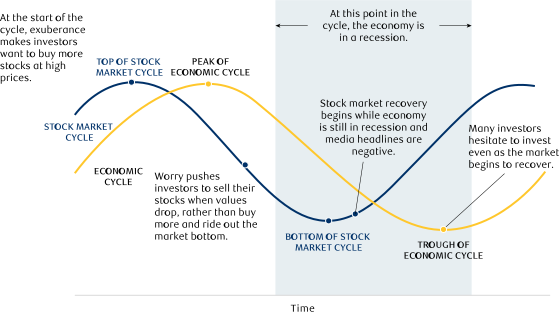
The stock market is a forward-looking indicator, meaning it prices in expectations of future economic conditions, earnings, and interest rates—often before GDP data reflects them.
Example:
- In 2009, GDP was still negative, but the S&P 500 began a massive bull market starting in March.
- In 2022, GDP growth remained positive for much of the year, but the stock market declined sharply due to interest rate hikes and inflation fears.
When the Correlation Breaks
Here’s why the stock market and GDP don’t always move together:
1. Timing Lag
- Stock markets anticipate future GDP, not current or past performance.
2. Different Measurement Units
- GDP measures domestic economic output.
- The S&P 500 includes multinational companies that generate large portions of revenue outside the U.S.
For example, Apple earns more than 50% of its revenue globally—GDP may rise, but their profits could fall due to global issues.
3. Corporate Profits ≠ GDP
- GDP growth doesn’t guarantee higher corporate earnings.
- High inflation or labor costs can erode profit margins, even in a growing economy.
4. Federal Reserve & Interest Rates
- The Fed’s actions have massive influence.
- In a growing economy, rate hikes to fight inflation may hurt stock valuations, even if GDP is strong.
Historical Analysis: Correlation Insights
According to studies by the Federal Reserve and academic institutions, the long-term correlation between stock market returns and GDP growth is low to moderate.
- Over decades, they generally move in the same direction, but year-to-year fluctuations often diverge.
- Globalization, innovation, and corporate dynamics make stock market behavior more complex than simply tracking GDP.
Real-World Examples
High GDP + Weak Market (2022)
- U.S. GDP grew 2.1%, but the S&P 500 fell ~18% due to inflation and Fed policy fears.
Weak GDP + Strong Market (2009)
- GDP was negative or flat, but markets surged on expectations of recovery and QE stimulus.
Balanced Example (2017)
- GDP rose ~2.4%, and markets rallied over 19% as earnings growth and tax cuts boosted sentiment.
Implications for Investors
So, how should smart investors approach GDP data?
1. Use GDP as Context, Not a Guide
- GDP tells you where the economy has been.
- The market cares more about where it’s going.
2. Focus on Earnings Growth
- Corporate profits and guidance are better indicators of stock market potential than GDP figures.
3. Understand Sector Sensitivity
Different sectors respond differently to GDP growth:
| Sector | GDP Growth Impact |
|---|---|
| Consumer Discretionary | High correlation |
| Industrials | High correlation |
| Tech | Less dependent on GDP, more on innovation |
| Healthcare | Relatively stable |
| Utilities | Defensive, less GDP-sensitive |
4. Diversify Globally
- If GDP slows in the U.S., global markets may still provide opportunity.
- Use international ETFs or mutual funds to hedge country-specific risk.
5. Watch the Fed and Earnings Season
- Fed interest rate decisions and earnings guidance often move markets more than GDP releases.
Final Thoughts
While GDP is a valuable macroeconomic tool, it’s not a crystal ball for stock market performance. The U.S. economy and the markets can—and often do—move in different directions, especially in the short term.
For long-term investors:
- Use GDP to gauge economic trends
- Focus more on earnings, interest rates, and valuations
- Maintain a diversified, goal-based investment strategy