
In the dynamic world of investing, the choice between small-cap and large-cap stocks has always been a critical decision point for investors. In 2025, this debate is more relevant than ever, as the stock market is showcasing divergent growth paths across different market capitalizations.
Small-cap stocks—once seen as nimble growth machines—are facing an uneven recovery. Meanwhile, large-cap giants, especially in tech and AI, are powering ahead with multi-billion-dollar valuations and dominant market presence.
In this edition of Growth Watch, we take a deep dive into the performance, risk factors, growth potential, and investor sentiment surrounding small-cap vs. large-cap stocks in the U.S. equity markets in 2025.
What Are Small-Cap and Large-Cap Stocks?
Before diving into trends and analysis, let’s briefly define the two:
- Small-Cap Stocks: Publicly traded companies with a market capitalization between $300 million to $2 billion. These firms are often newer, growth-oriented, and more volatile.
- Large-Cap Stocks: Companies with market capitalizations over $10 billion. They tend to be well-established, financially stable, and more resilient during downturns.
Other categories exist, such as mid-caps, but for this analysis, we’ll focus on the two ends of the spectrum.
2025 Market Overview: The Year of Divergence
As of mid-2025, the stock market has entered a phase of narrow momentum—led primarily by large-cap technology stocks—while small-cap stocks lag behind. This divergence is visible across indices:
| Index | YTD Performance (as of July 2025) |
|---|---|
| S&P 500 (Large-Cap) | +12.3% |
| Nasdaq 100 (Tech-Heavy Large-Cap) | +18.7% |
| Dow Jones Industrial Average | +5.8% |
| Russell 2000 (Small-Cap) | -0.9% |
This split raises a crucial question: why are small-caps underperforming despite economic growth, and should investors be rotating their portfolios?
Large-Cap Stocks in 2025: Powering Ahead with Innovation
Large-cap stocks, particularly those in the technology, healthcare, and consumer discretionary sectors, are enjoying a strong run in 2025. Much of this is driven by:
1. AI and Automation Dominance
- Companies like Nvidia, Microsoft, Amazon, and Alphabet are leading the charge in monetizing artificial intelligence.
- Cloud infrastructure, data processing, and AI tools are becoming core revenue streams.
2. Global Market Penetration
- Large-cap multinationals benefit from international sales, hedging against domestic slowdowns.
- They have access to diversified revenue channels and stronger supply chains.
3. Strong Balance Sheets
- High cash reserves and access to capital allow large-caps to invest in innovation, M&A, and R&D.
- Dividend payouts and stock buybacks attract long-term investors.
4. Institutional Investor Preference
- Pension funds, mutual funds, and ETFs favor large-caps due to liquidity and stability.
- Their dominance in major indices ensures consistent fund flows.
Key Performers:
- Microsoft (MSFT): Leveraging Copilot AI across enterprise software.
- Apple (AAPL): New hardware + services ecosystem driving growth.
- Eli Lilly (LLY): Dominating weight-loss drug market.
- Tesla (TSLA): Rebound in EV deliveries and software subscriptions.
Small-Cap Stocks in 2025: Growth Potential Meets Volatility
Small-cap stocks have historically outperformed during early-stage economic recoveries and periods of interest rate cuts. However, in 2025, their performance has been mixed due to several factors:
1. Interest Rate Pressure
- While inflation has cooled, interest rates remain elevated compared to pre-2020 levels.
- Small companies rely more heavily on borrowing, making them vulnerable to high financing costs.
2. Limited Access to Capital
- Unlike large-caps, small firms face challenges in raising equity or debt.
- Venture capital and private equity funding have also tightened post-2022 bubble.
3. Higher Risk Perception
- Economic uncertainty, geopolitical tensions, and credit market instability make small-caps riskier in the eyes of investors.
- Lack of visibility, weak earnings, or unproven business models contribute to volatility.
4. Under-Exposure to AI Boom
- Most small-caps are not directly involved in the AI revolution.
- Their growth is often tied to traditional industries or early-stage tech.
Still, Bright Spots Exist:
- Select Biotech firms with FDA approvals
- Niche SaaS companies serving underserved markets
- Green energy startups benefiting from state-level subsidies
Case Study: Small-Cap vs. Large-Cap Stock Examples
Let’s compare two hypothetical investments made in January 2025:
Investor A buys:
- $10,000 in Nvidia (NVDA) at $550/share → currently valued at $700/share → ~27% return
Investor B buys:
- $10,000 in Plug Power (PLUG), a small-cap hydrogen energy firm, at $10/share → now at $8/share → -20% return
This simplified comparison reflects broader market behavior: small-caps require more risk tolerance and time, whereas large-caps are delivering more immediate, AI-driven returns.
Where Are the Growth Opportunities Going Forward?
Large-Caps Will Likely Continue Leading Short-Term Momentum
- Especially those tied to AI, semiconductors, cloud services, and consumer platforms.
- Mega-cap tech companies still have room to grow globally.
Small-Caps Could Outperform in Late 2025 to 2026
- If the Federal Reserve begins rate cuts, small-cap firms will benefit from lower financing costs.
- Market rotation into undervalued, growth-oriented companies is possible.
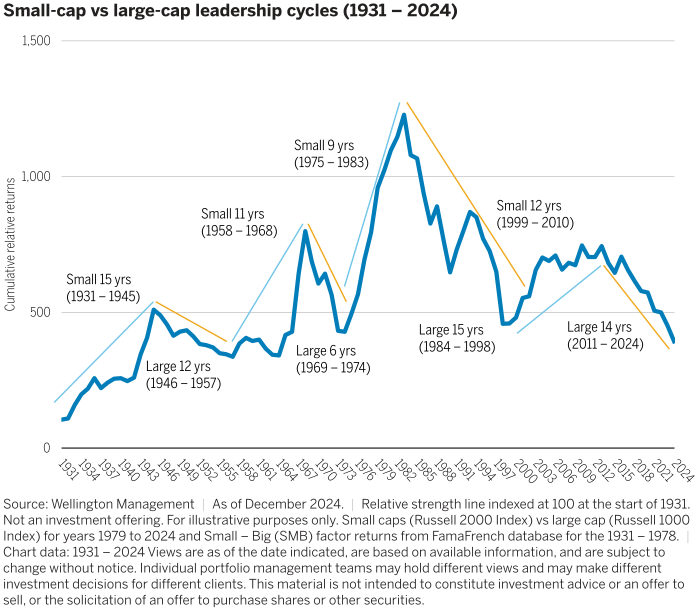
- Historically, small-caps outperform large-caps in the 12-18 months after peak interest rates.
Key Indicators to Watch:
- Fed policy direction
- Inflation and labor market trends
- Credit markets and lending conditions
- Small-cap earnings surprises and innovation activity
Valuation Metrics: Small-Cap vs. Large-Cap in 2025
| Metric | Large-Caps | Small-Caps |
|---|---|---|
| Forward P/E (Avg.) | 24x | 16x |
| Dividend Yield | 1.2% | 0.6% |
| Volatility (Beta) | 1.1 | 1.7 |
| Return YTD (avg) | +10–15% | -2% to +3% |
| Debt-to-Equity Ratio | Low to Moderate | Moderate to High |
Despite lagging in returns, small-caps look more attractively valued, which could entice contrarian investors and long-term growth seekers.
Portfolio Strategy: Balancing Small-Cap and Large-Cap Exposure
Conservative Investor:
- 80% Large-Cap / 20% Small-Cap
- Focus on dividend-paying, blue-chip companies
- Use small-cap ETFs like IWM for diversified exposure
Moderate Risk Investor:
- 60% Large-Cap / 40% Small-Cap
- Target sectors with upside: healthcare, fintech, sustainable energy
- Combine individual small-caps with broad-based funds
Aggressive Growth Investor:
- 40% Large-Cap / 60% Small-Cap
- Focus on early-stage tech, biotech, and turnaround stories
- Consider micro-cap exposure for higher risk/reward
Expert Opinions & Market Sentiment
What Wall Street Analysts Are Saying:
- Goldman Sachs: “Large-caps are fully valued, small-caps present untapped opportunities by Q4 2025.”
- Morgan Stanley: “Expect a cyclical rotation into small-caps once interest rates begin easing.”
- Morningstar: “Valuations make small-caps a compelling long-term value play.”
Retail Sentiment:
- Many retail investors remain focused on trending large-cap names.
- Finfluencers and Reddit communities are starting to talk more about undervalued small-cap opportunities.
Final Thoughts: Which Cap Is the Right Fit in 2025?
The small-cap vs. large-cap debate in 2025 comes down to your investment horizon, risk appetite, and market outlook.
- Large-cap stocks are leading the market rally—fueled by AI, innovation, and financial strength. They remain a cornerstone for stability and growth.
- Small-cap stocks, though underperforming now, may offer significant upside if macroeconomic conditions shift—particularly in a rate-cutting or stimulus environment.
Smart investors are not choosing one over the other—they’re blending exposure, managing risk, and keeping a close watch on the evolving landscape.
Conclusion: Keep Both Eyes on the Cap Spectrum
Growth in 2025 is not uniform. Large-caps dominate headlines, but small-caps may soon dominate returns.
Use tools like:
- ETFs (SPY, QQQ, IWM)
- Sector-specific research
- Earnings calls and macro reports
to build a portfolio that’s agile, informed, and aligned with your personal goals.
Stay tuned to WealthInStock.us as we continue tracking the momentum and uncovering smart investment opportunities in both giant firms and hidden gems.