

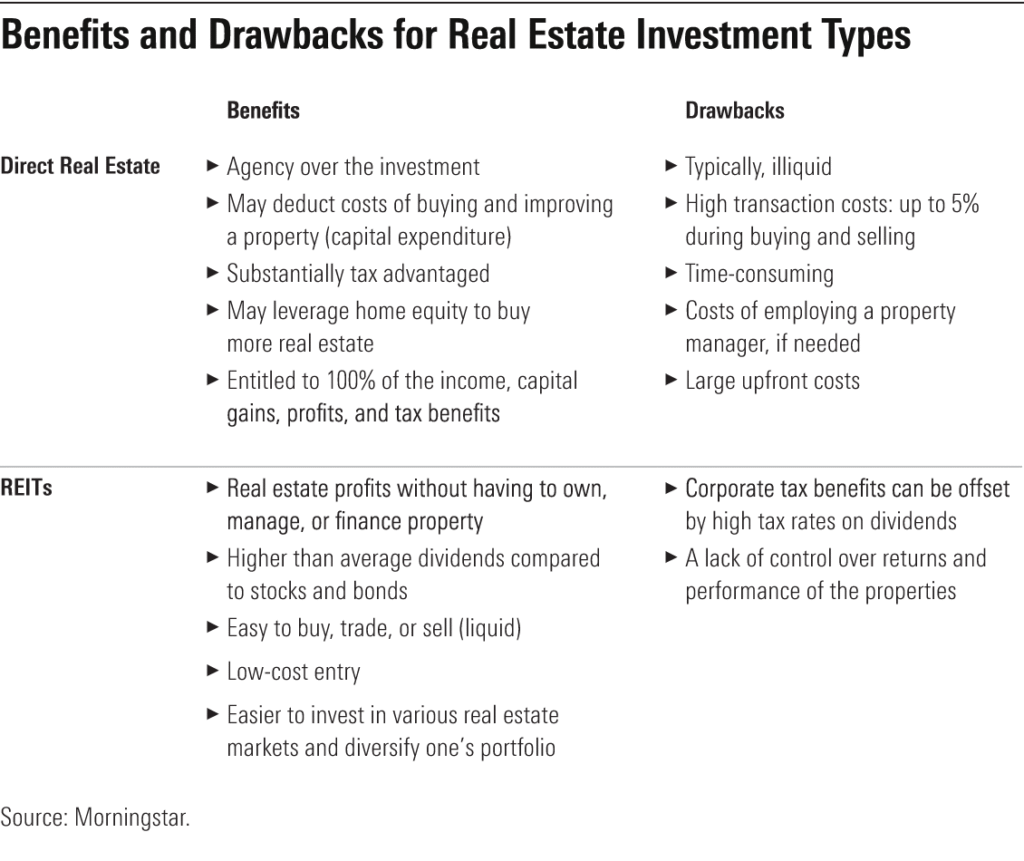
1. Overview: What You’re Comparing
- REITs (Real Estate Investment Trusts): Publicly traded companies that own, manage, or finance income-generating properties like apartments, commercial buildings, data centers, or healthcare facilities. They must distribute at least 90% of taxable income as dividends and offer stock-like liquidity
- Traditional Real Estate: Buying physical real estate—like rental homes, multifamily units, commercial buildings—directly. Investors manage, rent, and finance these properties themselves or through property managers.
2. Advantages of REITs
✅ Low Barrier to Entry & Diversification
- You can start with a few hundred dollars, unlike buying a property requiring 20–30% down payment
- One REIT may own dozens or hundreds of properties across regions and sectors—instant diversification
✅ Liquidity & Simplicity
- Public REITs trade daily—easy to buy, sell, or rebalance your portfolio
- Professionally managed—no tenant issues, maintenance calls, or hands-on responsibilities.
✅ Regular, High Yields
- REITs must distribute at least 90% of income, resulting in high yields (~4–6%), significantly above average stock dividends (~1.3%)
- Certain sectors—healthcare, data centres, industrial, or retail—offer attractive yields and inflation protection
✅ Inflation Hedge & Tax Efficiency at REIT Level
- Rent escalations in long-term leases transfer inflation protection to tenants and REIT investors
- REITs themselves benefit from tax advantages; individual earnings are taxable as dividends
3. Drawbacks of REITs
⚠️ Interest Rate Sensitivity & Volatility
- Rising rates increase REIT borrowing costs and can weight on valuation—REITs often move inversely with bond yields
- Publicly traded REITs are subject to stock market swings, reducing their stability compared to physical real estate
⚠️ Tax Disadvantages
- REIT dividends are taxed as ordinary income—often at higher rates—compared to capital gains or qualified dividends .
- Unlike owners of physical real estate, REIT investors cannot benefit from depreciation, 1031 exchanges, or mortgage interest deductions
⚠️ Limited Growth & Control
- REITs must distribute most income, reducing retained earnings for acquisition or growth—potentially limiting share price appreciation
- Investors cannot influence property selection, management, or capital improvements
⚠️ Fees & Focus Risks
- Some REITs, especially non-traded ones, charge significant management and administrative fees
- Specialized REITs may concentrate risk in specific sectors—such as malls or office buildings—subject to industry-specific headwinds .
4. Advantages of Traditional Real Estate
✅ Control & Value Creation
- You decide where, how, and when to invest: rental pricing, renovations, tenant screening, refinancing—all fully under your control.
✅ Leverage & Tax Benefits
- Mortgages allow amplifying returns—for example, a 20% down payment can control 100% of a property
- Tax benefits include depreciation, mortgage interest, property taxes, and 1031 exchanges—reducing taxable income and deferring gains
✅ Stable Cash Flow & Appreciation
- Long-term leases and rent growth offer predictable monthly income.
- Physical real estate tends to appreciate over time, especially when leveraged and actively managed.
✅ Emotional & Tangible Ownership
- Owning property offers a sense of control, pride, and direct impact through upgrades and improvements.
5. Drawbacks of Traditional Real Estate
⚠️ High Capital Requirements & Illiquidity
- Down payments, closing costs, and reserves are substantial.
- Selling can take months; difficult to liquidate quickly without markdowns
⚠️ Active Management & Liability
- Involves screening tenants, coordinating repairs, legal compliance—time-consuming unless hired out .
- Owners are liable for property issues, vacancy losses, and emergencies—though insurance helps mitigate some risks.
⚠️ Geographic Concentration & Market Cycles
- Most investors lack diversification; a single market slowdown or disaster can heavily impact returns .
- Local laws—like rent control—can restrict profitability.
⚠️ Ongoing Costs & Cash Flow Risks
- Vacancies, repairs, HOA dues, insurance, and taxes eat into returns—requiring reserve budgets and risk planning.
6. Comparative Summary Table
| Feature | REITs | Physical Real Estate |
|---|---|---|
| Capital Needed | Low (hundreds of dollars) | High (20–30% down payment) |
| Liquidity | High (trade anytime) | Low (months to exit) |
| Diversification | High—across sectors and geography | Typically low; need multiple properties |
| Leverage | Embedded in REIT structure | Flexible via mortgages |
| Tax Benefits | Limited; dividends taxed as income | Many deductions, depreciation, 1031 exchange |
| Control | No control over management | Full control |
| Growth Potential | Moderate—limited reinvestment | Potentially higher via leverage and upgrades |
| Income Yield | 4–6% typical dividends | Varies; 5–10%+ net rental yields |
| Management Effort | Minimal—handled by REIT teams | High unless outsourced |
| Volatility | Correlated with stock market | More stable; localized risks |
| Inflation Hedge | Rents escalate automatically in leases | Same, with rent resets on renewal |
7. When to Choose Each
REITs Make Sense If You:
- Seek passive income with minimal time commitment.
- Have limited capital but want real estate exposure.
- Want easy liquidity and professional property management.
- Prefer diversification with broad market access.
Direct Real Estate Is Better If You:
- Want leverage, tax deductions, and hands-on control.
- Can manage properties actively or afford experienced managers.
- Plan to build equity through rent growth and asset appreciation.
- Prefer customizing and optimizing each property.
8. A Hybrid Approach: The Best of Both Worlds
Many investors blend both strategies:
- Use REITs for diversification, liquidity, and sector access (e.g., data center, healthcare).
- Invest directly in a few properties for control, leverage, and tax benefits.
- Engage in syndications or fractional platforms to gain exposure with less capital and effort.
9. Market & Economic Context in 2025
- REITs have become one of the best-performing sectors, offering 4–6% yields with inflation protection. They’ve benefited from shrinking supply and strong rental demand, though high interest rates still limit upside
- Direct real estate sees robust rental income, especially in Sunbelt and secondary markets, but remains capital-intensive and management-heavy.
10. Investor Case Scenarios
- Sarah (young professional): Invests $5,000 in a Vanguard REIT index fund for passive income and diversification; she’s building cash reserves toward a future rental property.
- James (mid-career): Uses a mortgage to buy a duplex, rents both units, amps up cleanup and minor upgrades, and benefits from depreciation plus rent income ($8K/year) and eventual equity growth.
- Pat & Maria (semi-retired): Own a rental condo and $50K in REITs. REITs provide tax-diversified income, while the condo offers higher yields and hands-on control with property manager support.
✅ Final Takeaway
There’s no one-size-fits-all answer between REITs and traditional real estate.
- For passive, liquid, diversified income, REITs are excellent.
- If you prefer control, leverage, tax advantages, and active involvement, direct real estate makes sense.