

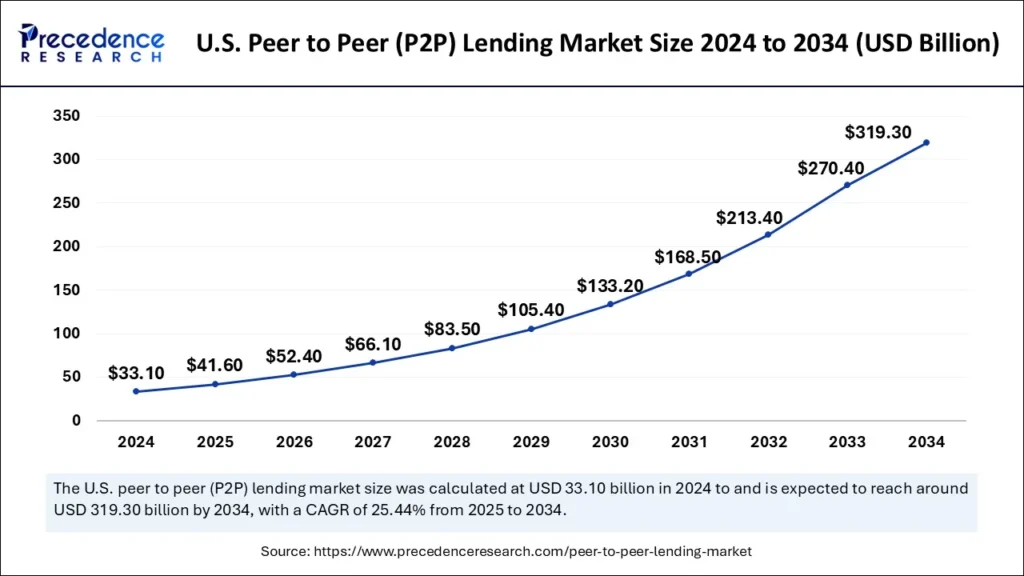
In recent years, peer-to-peer (P2P) lending—where individual investors fund loans to others via online platforms—has surged as a viable investment strategy in the U.S. In 2025, the P2P lending landscape is evolving rapidly: market size is expanding, technology is enhancing risk assessment, and regulatory attention is increasing. For investors chasing steady returns of 6–12%, this ecosystem offers compelling appeal—but not without significant trade-offs.
Let’s explore why P2P lending is gaining momentum, how it delivers returns, key platforms, emerging innovations, and vital risks every investor should understand.
1. Why P2P Lending Is Booming 📊
🌎 Massive Market Growth
- In 2025, the global P2P lending market is estimated at $176.5 billion, and projected to reach $1.38 trillion by 2034, growing at a 25.7% CAGR
- The U.S. leads North America, accounting for approximately 63% of region-wide volume
💳 Investor Appeal Over Traditional Fixed Income
- Platforms advertise mid to high single-digit yields, typically between 6%–12% depending on borrower profiles .
- In a low-to-moderate interest rate environment, such yields can outperform traditional CDs and bonds.
🔍 Diversification & Democratization
- Investors can start with small amounts—often as little as $25 per loan—spreading risk across dozens of borrowers
- P2P opens access to private credit markets usually reserved for institutional investors
🛠️ Tech-Driven Innovation
- Platforms increasingly incorporate AI and alternative data to improve borrower screening
- Blockchain and smart contracts on some sites enhance transparency and security
2. How P2P Works: The Basics
- Loan Listings: Borrowers apply; platforms assign credit grades and projected returns.
- Investor Funding: You fund part of the loan, spreading risk across multiple borrowers.
- Repayment: Borrowers repay principal + interest monthly; you receive distributions.
- Passive Income: Regular payments can provide steady monthly income.
Platforms like Prosper, LendingClub, Funding Circle, and niche players like Groundfloor (focused on real-estate), enable various loan types—from personal loans to small-business and real-estate loans. For example, Prosper has funded over $23 billion in personal loans and historically delivered around 10.7% net returns (2009–2011) Groundfloor offers ~12% annual returns on short-term real-estate loans .
3. Return Expectations by Risk Tier
- Low-risk loans (high-credit ratings): Anticipated yields of 4–6%
- Mid-tier loans: Yields of 7–10% .
- High-risk loans: Possible yields of 11–15%+, but with elevated default risk
Returns are net of platform fees and defaults; well-structured portfolios can consistently earn 6–10% over time
4. Leading U.S. P2P Platforms
- Prosper — America’s first P2P lender with a long track record. It offers unsecured personal loans with transparent performance data .
- LendingClub — Among the largest, offering both personal and small-business loans (similar returns).
- Funding Circle — Focused on U.S. small-business loans; expanded from the UK market
- Groundfloor — Niche platform offering higher-yield short-term real-estate loans (~12%)
- Emerging platforms — Apps like SoLo Funds target microloans with community-first lending; note regulatory scrutiny and risk
5. Innovation & Tech Trends in 2025
🧠 AI-Powered Underwriting
- Advanced algorithms now assess non-traditional data: social behavior, utility payments—helping underwrite borrowers with limited credit history
🔐 Blockchain for Trust & Transparency
- Smart contracts reduce escrow friction; transparent records enhance accountability .
🌐 DeFi & Marketplace Lending Evolution
- Some platforms are exploring DeFi models—automated, decentralized lending via programmable protocols
6. Key Risks to Navigate
| Risk Type | Description |
|---|---|
| Credit / Default Risk | Borrowers may default—higher in economic downturns |
| Platform Risk | If a P2P platform fails or mishandles loans, investors can lose money . |
| Liquidity Risk | Loans often lock in capital until term-end (no easy sale) . |
| Regulatory Risk | Platforms face evolving SEC, CFPB oversight—rules may affect returns . |
| Technology / Fraud Risk | Cybersecurity and fraud (e.g., synthetic identity, loan-stacking) are growing concerns . |
| Economic Cycles | Recessions can drive default spikes—regular monitoring needed . |
| Prepayment Risk | Borrowers may prepay, reducing expected yield . |
7. Risk Management & Best Practices
- Diversify across loans
Spread investments over dozens or hundreds of loans to minimize impact of defaults - Choose credible platforms
Evaluate historical performance, default rates, platform stability, and user reviews - Match risk to yield
Balance safe, mid-tier, and high-risk loans in line with your goals - Use automated tools
Leverage automated allocation, AI-driven scoring, and provision-decision systems - Monitor macro trends
Watch unemployment, consumer debt levels, and recession indicators to anticipate rising defaults - Plan liquidity needs
Only commit funds you can leave invested for the full term (~3–5 years)
8. Who’s a Good Fit?
- Income-seeking investors who want yields above bonds and CDs.
- Retail investors aiming to diversify into private credit.
- Tech-savvy individuals comfortable with fintech tools and risk.
- Do-it-yourself allocators who can actively manage loan portfolio risk.
Not ideal for investors requiring high liquidity, deposit insurance, or zero-volatility returns.
9. Looking Ahead: Growth & Regulation
- Regulatory oversight ramping up: The SEC and CFPB are pushing platforms to improve disclosures, protections, and risk controls
- Technology continues to evolve: Expect more AI credit models, blockchain integration, and DeFi experimentation .
- Retail access expanding: As platforms become more streamlined, and tax-advantaged retirement accounts include P2P options, it’s becoming easier for households to participate
10. Final Verdict: Does P2P Lending Deliver?
Yes—with discipline, P2P lending can be a strong source of passive income (6–10%) in today’s market—but it’s not a risk-free substitute for bonds. Considering the liquidity constraints, default exposure, and regulatory uncertainties, it’s best suited as a complement to a diversified income strategy.
✅ If You Consider P2P Lending:
- Start small and diversify across many loans.
- Choose trustworthy platforms with track records.
- Use automated tools to streamline allocation.
- Be ready to hold investments to maturity.
- Adjust your portfolio based on economic cycles and performance.
📌 Key Takeaways
- The U.S. P2P lending market is thriving—$176B today, projecting nearly 8× growth by 2034
- Typical net investor returns fall in the 6–12% range, depending on risk tier
- Tech innovations (AI credit scoring, blockchain) are improving accuracy, efficiency, and platform trust .
- Main risks include loan defaults, platform solvency, illiquidity, regulatory pressure, and cybersecurity
- Following best practices—diversification, due diligence, and macro awareness—can help build a reliable P2P income portfolio.